
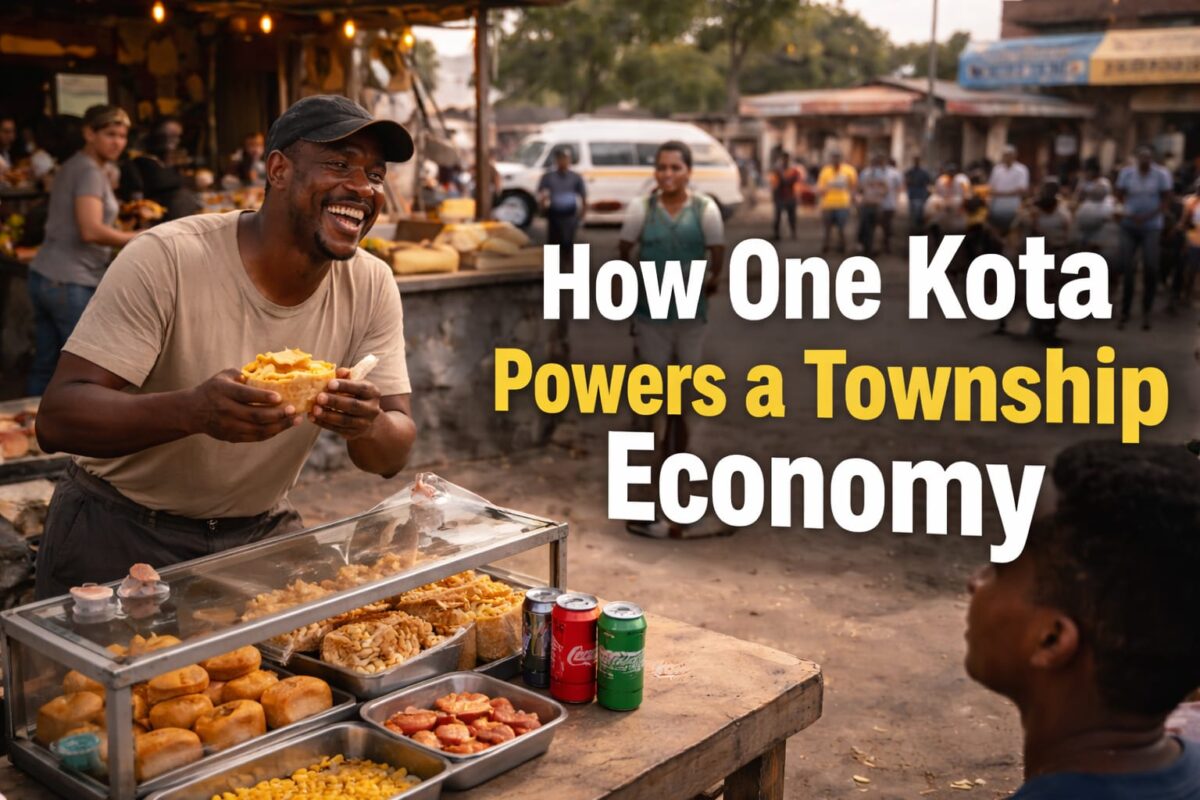
A kota might look like simple street food, but behind every kota sold is a small economic network at work. Bakers, suppliers, vendors, and customers are all connected through everyday transactions that keep money circulating inside the community.
In this article you will learn:
- How a single kota sale connects multiple local businesses
- Why township hustles are often part of larger economic systems
- How community assets like skills, suppliers, and street markets support local trade
- Why understanding these systems can help entrepreneurs build stronger businesses
Most people think a kota is just street food, but look closer and you’ll see something bigger, a township economy at work…Behind every kota sold on a street corner is a network of suppliers, vendors, and customers that keeps money circulating inside the community.
Most hustles don’t fail because of lack of effort, they fail because there is no system behind them.
In this conversation, Cornac Russell and John McKnight explore the philosophy behind Asset-Based Community Development (ABCD) — the idea that communities grow by recognizing the assets they already have. Instead of focusing on problems, this approach looks at the skills, relationships, and local businesses that already exist in the community.
👉 Get Looking Back to Look Forward on Amazon
Some of the links on this website may be affiliate links. Learn more
The idea behind Asset-Based Community Development becomes much easier to understand when you look at everyday township life. Take the simple example of a kota vendor.
When someone buys a kota on a street corner, they are not just buying food. They are participating in a small economic network. The vendor buys bread from a bakery. The bakery buys flour from a mill. The vendor buys chips from a supplier. Customers bring money into the system.
That single transaction connects people, businesses, and skills within the community, In other words, the township economy is not empty. It is already full of assets. You can see those assets everywhere: the people who know how to cook and sell, the stokvels that help people raise capital, the street corners where businesses operate, and the everyday exchanges that keep money circulating locally.
The kota economy is simply one visible example of how communities build their own systems of trade and support. Once you begin to notice these patterns, you realize that successful hustles are rarely random. They are usually built on systems, and understanding how systems work is what separates temporary hustles from sustainable businesses. That’s where the next book becomes useful.
This booklet offers a powerful analysis of the billions-worth township economy, including rural areas and overlooked communities. Using the Adjacent Possible theory, it explores how small local businesses, informal markets, and community networks create economic opportunities that are often invisible to traditional economic models.
It provides a deeper understanding of how township economies grow from the assets that already exist within communities.
From street vendors to small service businesses, township entrepreneurship shows how communities build systems of trade, support, and opportunity from within.
👉 Get The Future of Township Economies on Amazon
Some of the links on this website may be affiliate links. Learn more
Seeing the System Behind the Hustle
Once you begin to look at township businesses through this lens, you start to see patterns everywhere, a street vendor selling kotas is not operating alone.
They are connected to bakers, suppliers, customers, and community networks. Money flows through these relationships every day, creating a small but powerful economic system.
What might look like a simple hustle is actually part of a larger township economy built on skills, relationships, and local exchange. This is why understanding systems matters. When entrepreneurs begin to see the system behind their hustle, they can make better decisions, where to source products, where to operate, how to build relationships, and how to grow their businesses sustainably.
Why Township Economies Matter
Township economies are often overlooked in mainstream economic discussions, yet they represent one of the most dynamic forms of entrepreneurship, across South Africa, thousands of small businesses operate from street corners, garages, and local markets. These businesses provide goods, services, and employment within their communities. They also keep money circulating locally.
Every time someone buys from a local vendor, they are strengthening the economic network within that community.
The more these networks grow, the stronger the local economy becomes.
Looking Ahead
The future of township economies will depend on how well communities recognize and build on the assets they already have. Skills, associations, institutions, spaces, exchange, and culture are not abstract ideas , they are visible every day in the way people work, trade, and support one another.
Sometimes all it takes to see this system clearly is to look at something simple.
Even something as ordinary as a kota, because behind that single meal is a network of people, businesses, and relationships quietly powering a township economy.
Final Line
The next time you buy a kota, remember: you might not just be buying lunch , you might be participating in a local economic system in motion.
Next Read:
Explore more articles about township economies and kasi business ideas.
View all articles in the kasi Economy category
You must be logged in to post a comment.